Your comfortable hat has a folded brim; the online candidate lists a depth without saying whether its brim is folded. Start a comparison record with that missing detail visible, rather than choosing whichever size number looks closest.
The worksheet keeps head circumference, relaxed hat dimensions and wearing observations separate. Its invented 57 cm head and 52 cm relaxed hat example explains the distinction without prescribing a fit allowance.
Choose the wearing line
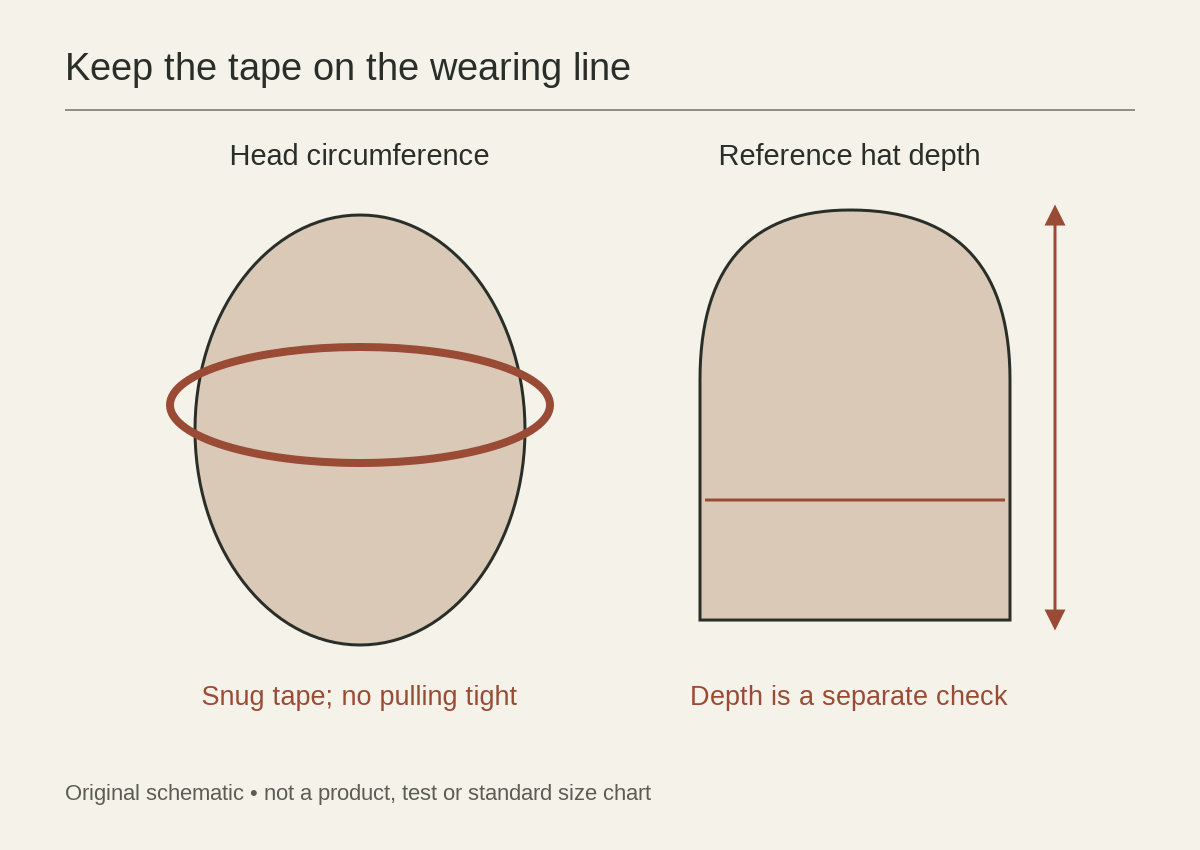
Position the tape across the forehead and around the fullest appropriate route for the intended band. The Craft Yarn Council’s guidance includes a head-circumference method; keep the tape level and note where it sits.
If you usually wear a hat lower over the ears, think about that position rather than measuring a completely different line. Ask another person to help if the tape slips or twists. Repeat the measurement using the same route to check that you have a usable record.
Do not pull the tape tighter to produce a smaller size. The purpose is to describe your head, not to imitate the tension of an unknown knit.
Copy a head-and-hat record
Date: ___ · unit: ___ · wearing-line description/photo key: ___ · usual glasses, hair or hood arrangement: ___
| Record | First reading | Same-route repeat | Route or condition |
|---|---|---|---|
| Head circumference | ___ | ___ | Tape position ___ |
| Dry reference hat, flat width | ___ | ___ | Relaxed band; brim folded/unfolded ___ |
| Reference hat, crown to edge | ___ | ___ | Route down front/side ___; brim condition ___ |
| Intended coverage | ___ | ___ | Above/over ears; preferred edge position ___ |
Candidate: seller/model/size ___ · stated figure: ___ · basis: head range / relaxed hat / stretched hat / unknown · depth route: ___ · maker’s fit reply and date: ___
These are separate records. The head reading does not prescribe a finished knitting circumference, and the relaxed hat reading does not establish comfortable stretch.
Translate the listing carefully
First identify the basis: intended head range, relaxed hat circumference, stretched hat or flat width. Doubling a comparable flat width may approximate a relaxed circumference, but does not establish comfortable stretch. Ask the maker how their chart connects the garment to its intended wearer.
Keep the glasses, hair and hood arrangement as context beside that answer, not a numerical addition to the circumference. Yarn, construction and lining affect fit; the alpaca hat guide supplies the wider material and selection context.
Compare head size and relaxed hat size
Imagine your repeated head measurement is 57 cm. One listing says ‘fits heads 56–58 cm’; another says ‘hat circumference 52 cm, unstretched’. The first is an intended head range. The second is a garment measurement and needs the maker’s fit guidance. You cannot decide that the second is unsuitable simply by subtracting the numbers.
If both were comparable circumferences, 52 − 57 = −5 cm would describe the difference. It would not establish that 5 cm of negative ease is comfortable or suitable for this knit. Ask about the intended head range, lining and depth before ordering. These figures are invented examples, not a hat-sizing standard.
If you use string because a flexible tape is unavailable, keep it level and avoid stretching it, mark the meeting point and measure that length against a ruler. A stretchy cord can make the result difficult to repeat. A helper and a proper flexible tape are useful when the route keeps slipping.
Name the depth route before comparing it
Use a dry reference hat in its normal relaxed shape. Choose a route from the crown to the edge, record whether it runs down the front or side, and note the brim position. A 22 cm route with the brim folded is not interchangeable with a 22 cm route measured to its unfolded edge. Do not stretch the hat to make the numbers agree.
Ask the seller for the same route and brim condition. In an invented record, ‘reference: 22 cm, front, brim folded’ and ‘candidate: 24 cm, brim condition unknown’ leave the comparison unresolved. The next useful question concerns the brim, not which hat has the larger size letter. The knit-hat selection guide owns the broader choice of crown, brim and coverage.
Add a wearing observation
If a fitting is possible, record whether the edge sits where your measurement note intended, including the usual glasses or hood. ‘Band stays above ears; front depth comfortable’ is an observation to keep beside the dimensions, not a thermal or safety test. Refer specialist-activity requirements to the product’s own guidance.
Keep the measurements after purchase
Save the seller’s description and care label alongside your record. If the hat later changes shape, the original information helps you ask a more precise question about care or repair.
For washing and drying decisions, use caring for alpaca knitwear. Keep your preferred wearing line with the number. “57 cm, band above the ears” is a better repeat record than an unexplained “medium”.