For an ordinary journey in a coat and glasses, ear coverage is a practical choice of shape. A chullo-style hat has separate flaps; a beanie relies on its continuous edge or folded cuff. The useful comparison happens at your ears, forehead and collar, rather than in the style name.
Follow the wearing line through fit and movement, then use two invented depth figures to see why the measurement route matters. The alpaca hat guide covers materials; no style-wide warmth result is claimed here.
Identify the coverage you need
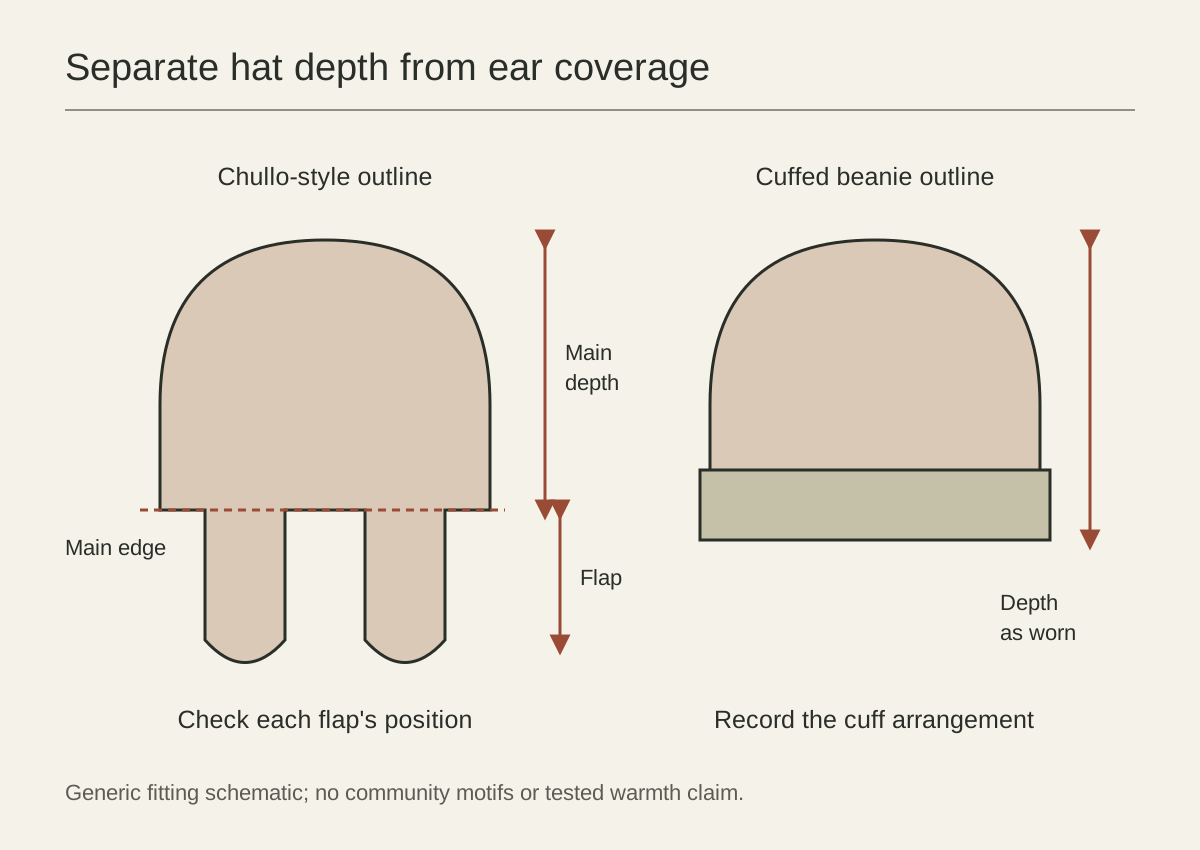
ASALE describes the chullo as an Andean hat with earflaps. That shape can provide a separate piece of fabric over each ear. Whether it reaches the right place depends on the depth, flap position and way the hat sits on your head.
A beanie without earflaps relies on the lower edge reaching the area you want covered. A cuff may change the available depth when folded, but its effect depends on the actual design. Ask for dimensions in the wearing arrangement shown, not just an unrolled length.
| Question | Chullo | Beanie |
|---|---|---|
| Where is the wearing edge? | Identify the main edge separately from flaps | Identify the edge or intended cuff fold |
| How do I check ears? | Check each flap’s position and reach | Check how low the continuous edge sits |
| What depth is listed? | Main crown depth or depth including a flap? | Cuffed, uncuffed or stretched? |
| What else needs inspection? | Ties, decorations and lining if present | Cuff bulk, seams and lining if present |
The diagram above separates the main edge from earflap coverage. It is a generic fitting schematic, not a culturally specific knitting pattern or evidence of tested cold-weather performance.
Measure at the intended wearing line
Use a flexible tape around the head where the hat will sit. Craft Yarn Council guidance measures across the forehead and around the full head circumference with a snug tape. For a buying record, also note your chosen wearing line so you can repeat it; do not pull the tape tight to obtain a preferred size.
Ask the seller whether a listed measurement is head circumference, relaxed hat circumference or a stretch range. These are different fields. A flat width doubled may approximate the circumference of a simple hat, but it is not automatically a fit guarantee for a shaped or lined item.
A hat can match a circumference figure and still sit too high or low. Record crown-to-main-edge depth separately from any earflap length. Do not assume a particular amount of negative ease is right for every alpaca knit, blend or lining.
Try a short movement check
For the planned journey, put on the glasses and coat. Where a fitting is permitted, place the hat at its intended line and adjust it without stretching the edge forcefully. Turn your head and look up and down. Notice whether it moves over your eyes, rides above your ears or presses at the forehead.
For a chullo, check both flaps with the hat in its ordinary position. Moving the whole hat down to make one flap reach may create a different problem at the front or back. For a beanie, check whether a cuff stays where intended or gradually rolls into a different depth.
Wear the glasses, scarf or coat collar you expect to combine with it. The hat choosing guide helps examine those contact points. This is a practical fitting, not a helmet compatibility assessment or a safety test. Do not add an unapproved layer under protective equipment on the strength of this guide.
Compare two listings without guessing
Imagine a chullo listing that gives “depth 27 cm” and a beanie listing that gives “depth 21 cm”. Those invented figures are not yet comparable. The first might run to an earflap tip, while the second might describe a folded cuff.
Ask for the crown-to-main-edge route on each, a separate flap length where relevant, and the circumference method. A photograph with those routes marked makes the comparison clearer. The longer advertised number does not by itself mean deeper forehead coverage.
For ties, ask how they are intended to be worn. Do not assume tying them will correct a poorly positioned or unsuitable hat. Small size and playful decoration also do not establish suitability for a child; children’s product safety requires a separate assessment.
Keep material and cultural claims separate
The Alpaca Owners Association’s fibre descriptions cannot supply a warmth ranking for two finished hats. Knit structure, dimensions and any lining need their own information. A style name does not prove alpaca content, and an earflap silhouette does not identify a particular maker or community.
Use the pattern-reading guide for careful cultural questions. When choosing between two hats, keep a record of the wearing line, circumference method, main depth, ear coverage and any pressure or movement. That provides a better basis for a purchase than choosing the style with the strongest unsupported warmth claim.