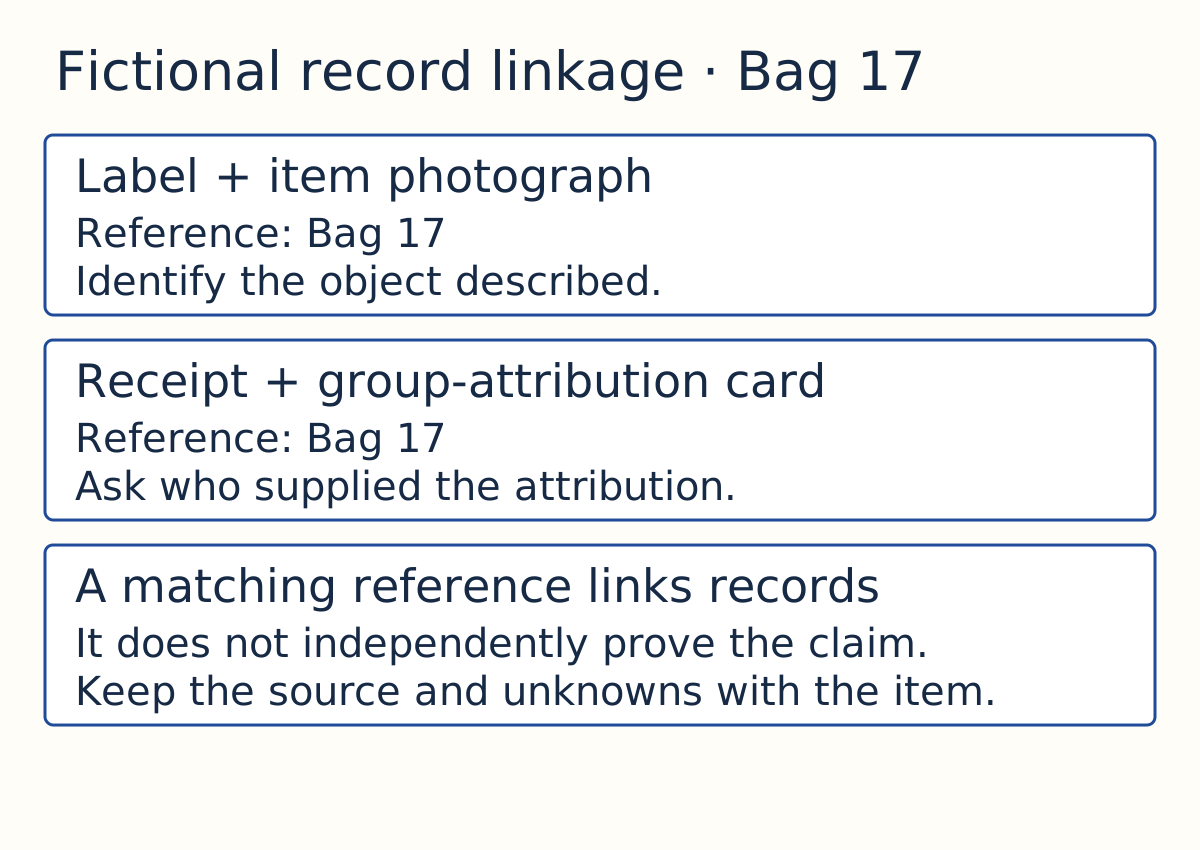
A maker card, a label and a receipt become more useful when they identify the same object. In the fictional example here, all three carry the reference “Bag 17”, while the card attributes weaving to a named group. That links the seller’s records; it does not independently authenticate the attribution.
Follow the item reference through the evidence and its limits. The Cusco buying guide covers the wider transaction; this article keeps an object’s claimed history traceable without filling gaps with a romantic story.
Separate the claims before comparing evidence
Ask what “made by an artisan” is intended to mean. Does the seller name the person who wove the textile, the association that supplied it or the workshop that assembled a bag from woven cloth? Those can be different contributions to one finished object.
Then separate place from process. Where a garment was assembled need not identify where the fibre was grown, spun or dyed. A composition label addresses a different question again. The Peruvian alpaca guide helps distinguish fibre descriptions from broader purchase claims.
Andean Resolution 2109 separates composition, responsible business and manufacturing origin. Article 3 limits it to the garment subheadings in Annex 1 when manufactured, imported or marketed within the Andean subregion, with stated exceptions including made-to-measure items and travellers’ personal baggage. It does not cover every handicraft or independently certify a maker’s provenance.
Match the record to its limited purpose
| Record or statement | What it may support | What needs separate evidence |
|---|---|---|
| Receipt identifying seller and item | A transaction with that seller | Who performed each making stage |
| Maker or association attribution attached to the item | A claimed connection to that maker or group | How the attribution was established |
| A photograph of work in progress | A documented stage if linked to this item | Earlier stages, fibre purity and payment |
| Fibre composition label | The declared material content | Independent testing and maker identity |
| An organisation’s programme description | Its account of its operating model | Whether this particular item passed through it |
“May support” is deliberate. A record’s value depends on whether it can be connected to the textile and on who supplied it. The table is not a ranking in which enough weak documents automatically become proof.
Connect the documents to the item
In the invented Bag 17 record, compare the item photograph and reference on the label, receipt and group-attribution card. If they identify different objects, the apparent paper trail has a gap. Save the listing, label, receipt and any written clarification together. If a maker attribution arrives on a separate card, ask how the seller connects that card to the piece you are buying.
Imagine an unsigned woven bag accompanied by a general cooperative leaflet. This is an invented example, not an allegation about a seller. The leaflet may explain an organisation’s work, but it does not alone establish that this bag came from that organisation. An item-specific record could answer a different question from the leaflet’s general story.
Keep changes visible. If a seller corrects an earlier attribution, preserve the explanation and the corrected record rather than quietly combining the two accounts. A clear correction can be more useful than apparent certainty with no traceable source.
Read an organisation’s account at the right scale
Awamaki describes working with independent artisan cooperatives, product development and market access. CTTC publishes named community accounts with different textile practices. These sources provide specific context for their own relationships and descriptions; they do not verify an unrelated shop’s stock.
If a seller claims affiliation with an organisation, ask how that relationship applies to the item and where it can be checked. Do not infer that a general donation, logo or shared geographic location establishes product-level oversight.
Claims about payment and working conditions also need their own explanation. Knowing a maker’s name is valuable, but it does not disclose every commercial arrangement. Ask what a fair-payment claim means in that seller’s model without presenting an unverified percentage as a fact.
Respect knowledge, privacy and attribution
A maker may be willing to describe a technique without sharing personal details or explaining every design. Lack of a portrait or public biography is not proof of deception. Ask permission before photographing people, recording explanations or sharing identifying information.
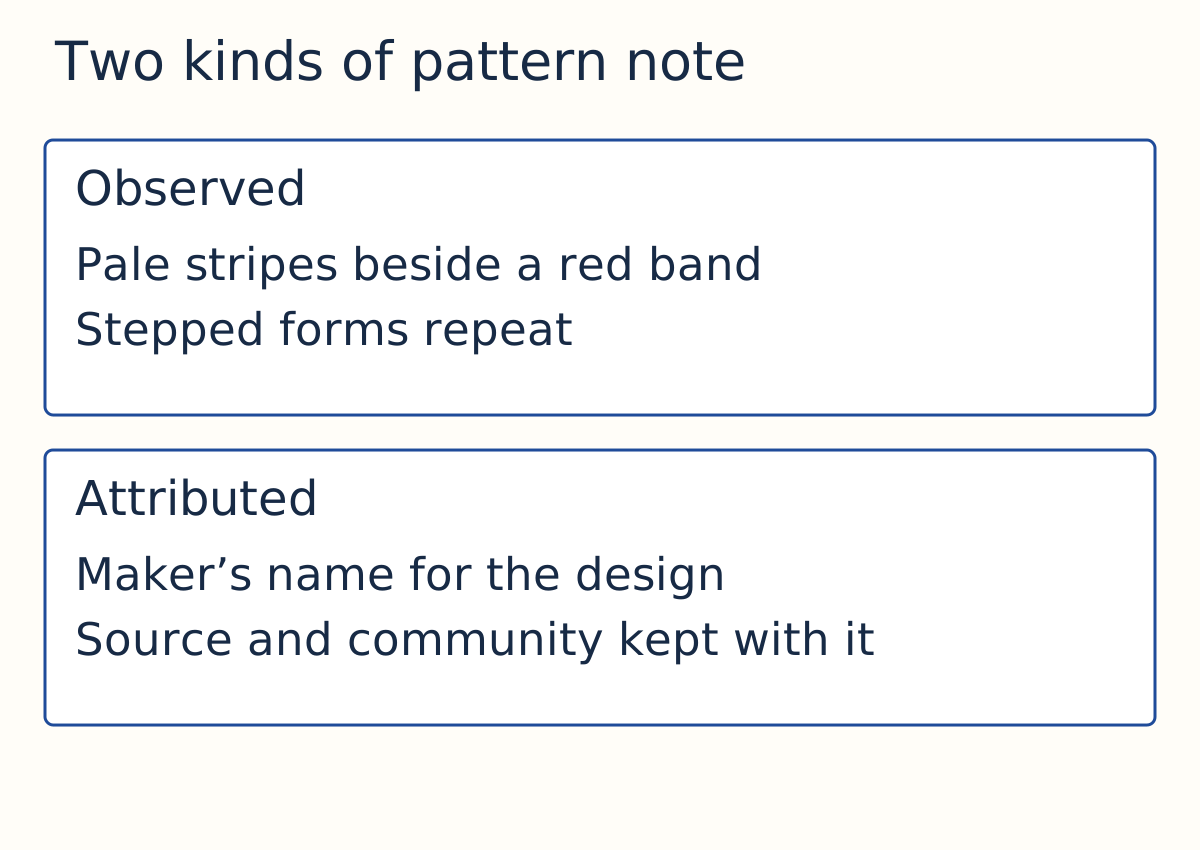
Likewise, ownership of a textile does not automatically settle rights to reproduce its design. The pattern-reading guide encourages attributed explanations. Do not assign a community, ceremonial role or motif meaning from visual resemblance alone.
The diagram uses fictional records, not a real maker portrait or authenticated product. Its matching reference explains record linkage; the source and truth of each statement still need assessing.
Keep a record with honest unknowns
Use three columns in your notes: claim, evidence, unresolved question. For example: “woven by a named association; seller’s item-specific tag; maker within the group not identified”. That is a more accurate record than upgrading an association name to a personal maker attribution.
If a crucial claim cannot be resolved, decide whether you are comfortable buying on the narrower evidence available. Leave unknown fibre stages, labour arrangements or design permissions unknown. Provenance is most useful when it makes the item’s history more traceable without claiming to answer questions the records do not address.