A photograph of a table runner leaves several decisions invisible: the finished panel width, whether its length includes fringe, and whether its design can appropriately be adapted. A hypothetical runner commission will carry us through those decisions, from finding a willing maker to agreeing what happens when a yarn changes.
The aim is a written brief both sides can understand and keep. The Cusco textile buying guide covers the wider purchase; this example concerns a woven commission, rather than a standard contract or a knitted sweater.
Identify the people and the object
Record who is taking the order, who will make it and who will answer production questions. Those roles may belong to different people. Agree one contact route and a language or translation arrangement that works for both sides.
Awamaki’s FAQ describes custom collaborations and independent artisan partners. That is one organisation’s operating model, not evidence that every weaver takes commissions or offers the same terms. Ask whether the maker wants this project and has capacity for it before negotiating its details.
For this example, begin with a table runner for domestic use, rather than a garment or an installation. Explain practical constraints such as a required finished width or a fabric edge that must sit flat. Ask which parts of that request suit the maker’s technique.
Make dimensions reproducible
Agree the measuring routes and units, whether figures describe the finished textile and whether fringe or other additions are included. Discuss a realistic tolerance with the maker; do not silently impose the precision of an industrially cut object on a process you have not discussed.
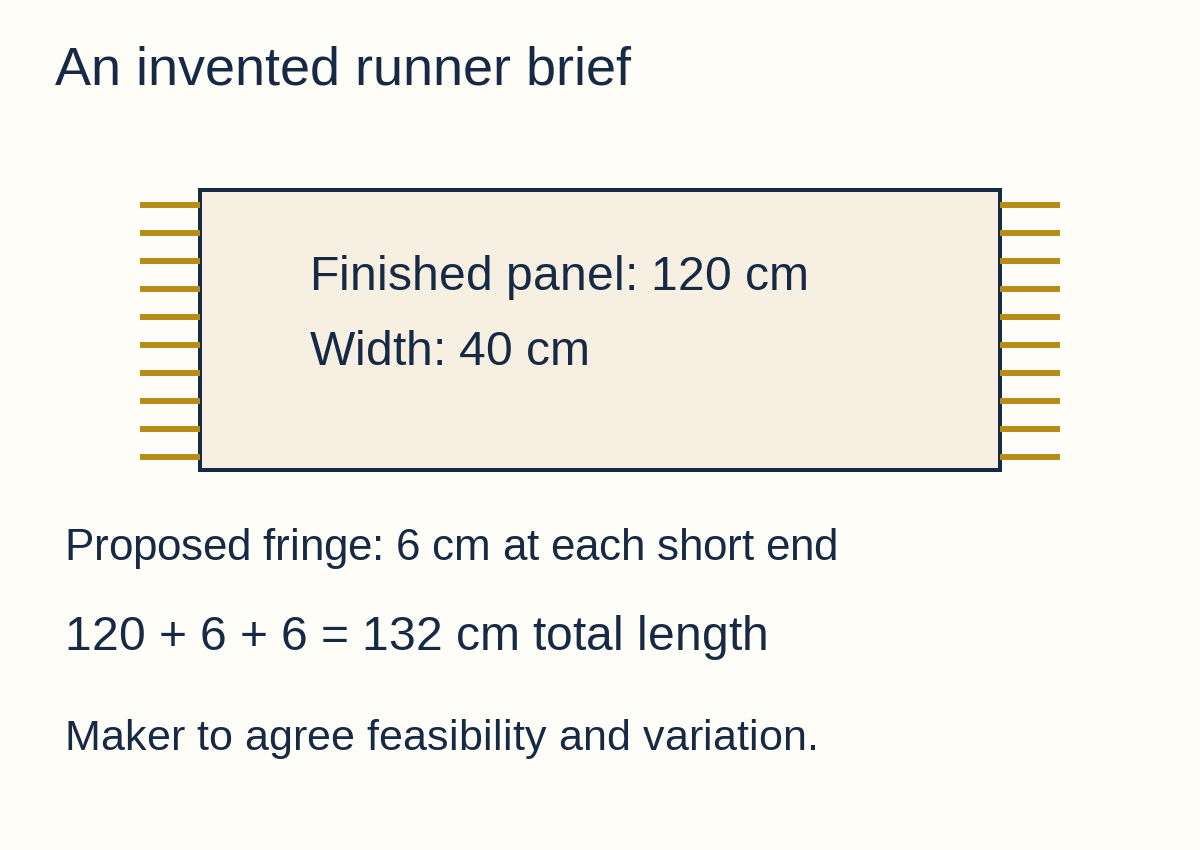
Here is an invented brief fragment, not a market standard: “Finished textile panel 40 × 120 cm, excluding fringe. Proposed fringe 6 cm at each short end. Maker to confirm feasibility and acceptable variation before order.” Along the length, that proposal would occupy 132 cm including both fringes if achieved as described. It is not a promise about a real textile’s dimensions.
Ask how joining panels, edge finishing and the chosen structure affect the proposal. The weaving guide explains why materials and construction deserve their own discussion. The brief diagram separates the panel from proposed fringe; it is a fictional agreement aid, not a weaving pattern or a maker’s acceptance of the project.
Use a brief both sides can complete
| Field | Write or attach | Decision needed before work |
|---|---|---|
| Object and use | Description and any reference image | Is the request feasible and appropriate? |
| Finished dimensions | Routes, units, fringe and agreed variation | Which size is being priced? |
| Materials | Fibre declaration, yarn and substitutions | Who confirms any change? |
| Design and colour | Agreed drawing or sample reference | What may be reproduced and how? |
| Cost and payment | Currency, included work, milestones and fees | What triggers each payment? |
| Completion and delivery | Agreed target, updates, collection or shipping | Who handles delay, loss or damage questions? |
| Changes and acceptance | Written change process and inspection point | What happens if requirements are not met? |
Blank fields are questions to resolve, not permission to guess. Keep the final version with a date or version identifier and obtain acknowledgement from both sides.
Agree colour and design without overclaiming
For the runner, a colour reference needs the same care as the measuring route. Screens and photographs can help the conversation but cannot promise an exact physical match. Discuss whether a yarn sample, small woven sample or an existing agreed textile is needed, what it will cost and what happens after it is reviewed. A sample approval should identify the sample and the decisions it settles.
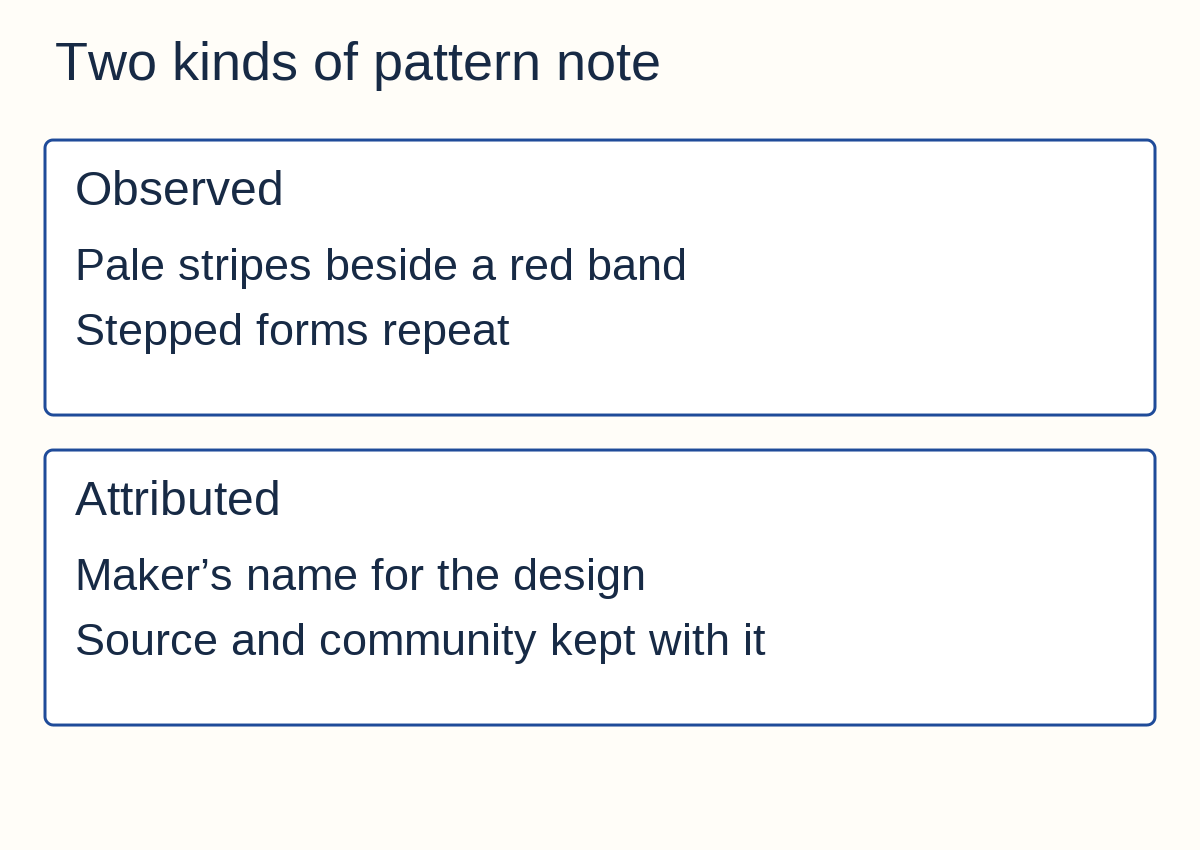
Do not assume a photograph grants permission to copy someone else’s design. Ask what the maker is comfortable adapting and how any culturally specific pattern should be described or credited. Our pattern guide helps frame questions without assigning universal meanings.
Awamaki describes product development as collaboration with its artisan partners. CTTC’s community accounts also document varied textile practices. Neither source turns an outside buyer’s reference image into an authorised design or makes every weaving method interchangeable.
Put changes through the same contact route
Suppose the agreed runner yarn becomes unavailable after the sample discussion. In this hypothetical situation, ask for the proposed replacement, its effect on appearance, composition, price and timing, and confirmation before it is used. Do not let a casual message about colour silently change fibre content as well.
Likewise, if you change the dimensions, ask for a revised cost and timeline. Record which version replaces the earlier brief. This protects a shared understanding of the work; it is not a claim that a particular wording creates an enforceable contract everywhere.
Price time and delivery explicitly
Agree the payment currency, payment stages and any sample, packaging, transport or intermediary charges. There is no universal deposit percentage in this guide. Ask what happens if either side cancels, work is delayed or delivery cannot be arranged as expected.
Separate completion from arrival. If shipping is involved, agree the destination, who arranges it and where responsibility questions should be directed. Seek current destination-specific advice for taxes, import requirements or other legal obligations rather than assuming they are included in a quoted making price.
Before paying for the runner, read the final brief back together, including unresolved fields. Keep the agreed version, payment records and messages. A good commission begins with a shared description and a willing maker, then stays understandable as the work develops.