A listing says “21 microns”. Before deciding whether that is useful, find out whether it is a sample mean, a range or a category limit. A micron measures fibre diameter; the kind of number and the material behind it determine what the claim tells you.
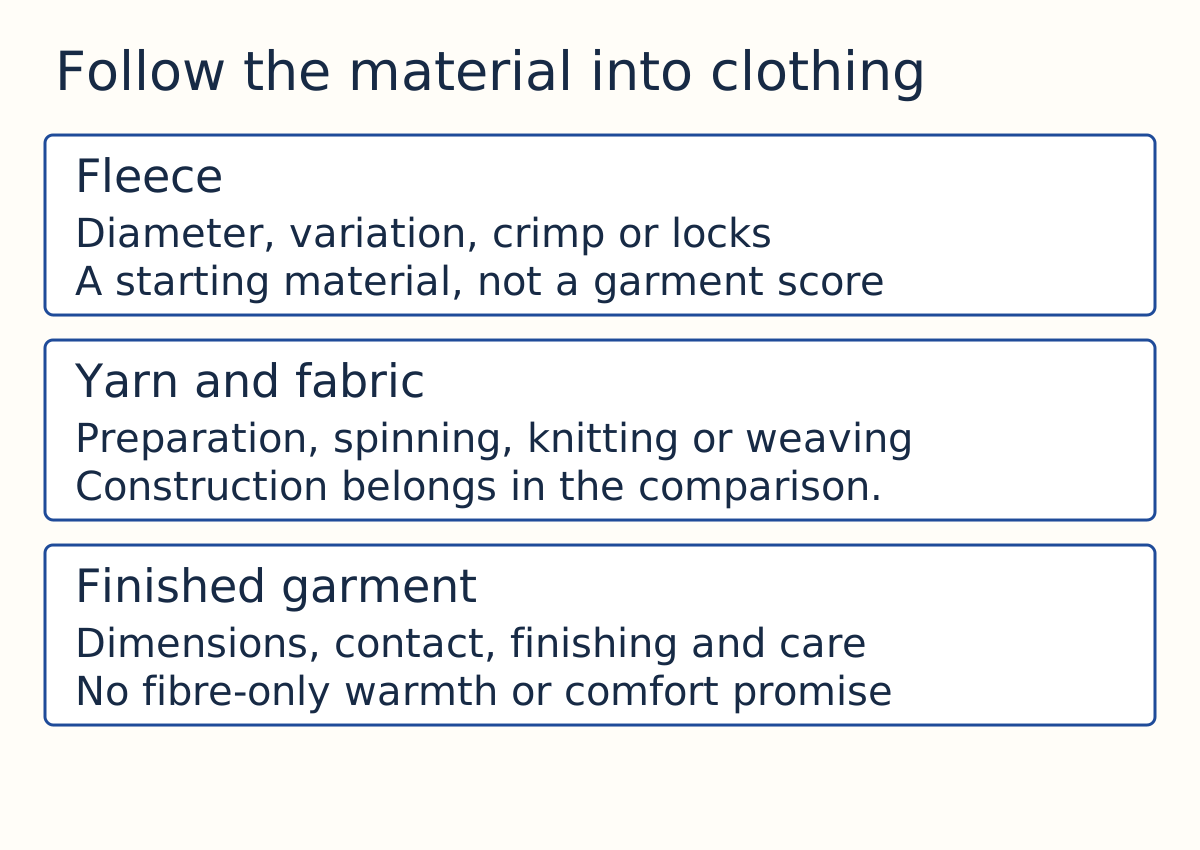
Follow one number from its unit through two invented samples to a report and its connection with a garment. The arithmetic is a reference exercise, not a prediction of comfort or a report of testing.
Start with the unit
One micrometre is one thousandth of a millimetre. In fibre discussion it is often called a micron. A diameter measurement concerns the thickness of an individual fibre, rather than the thickness of a yarn or knitted fabric.
Those three scales are easy to confuse. A substantial yarn can contain fine fibres, and a fine-looking yarn can still have variation among its component fibres. Fabric thickness also depends on the way the yarn is woven or knitted.
The alpaca wool overview explains why the finished material needs its own evaluation alongside the fibre information.
An average leaves a distribution behind it
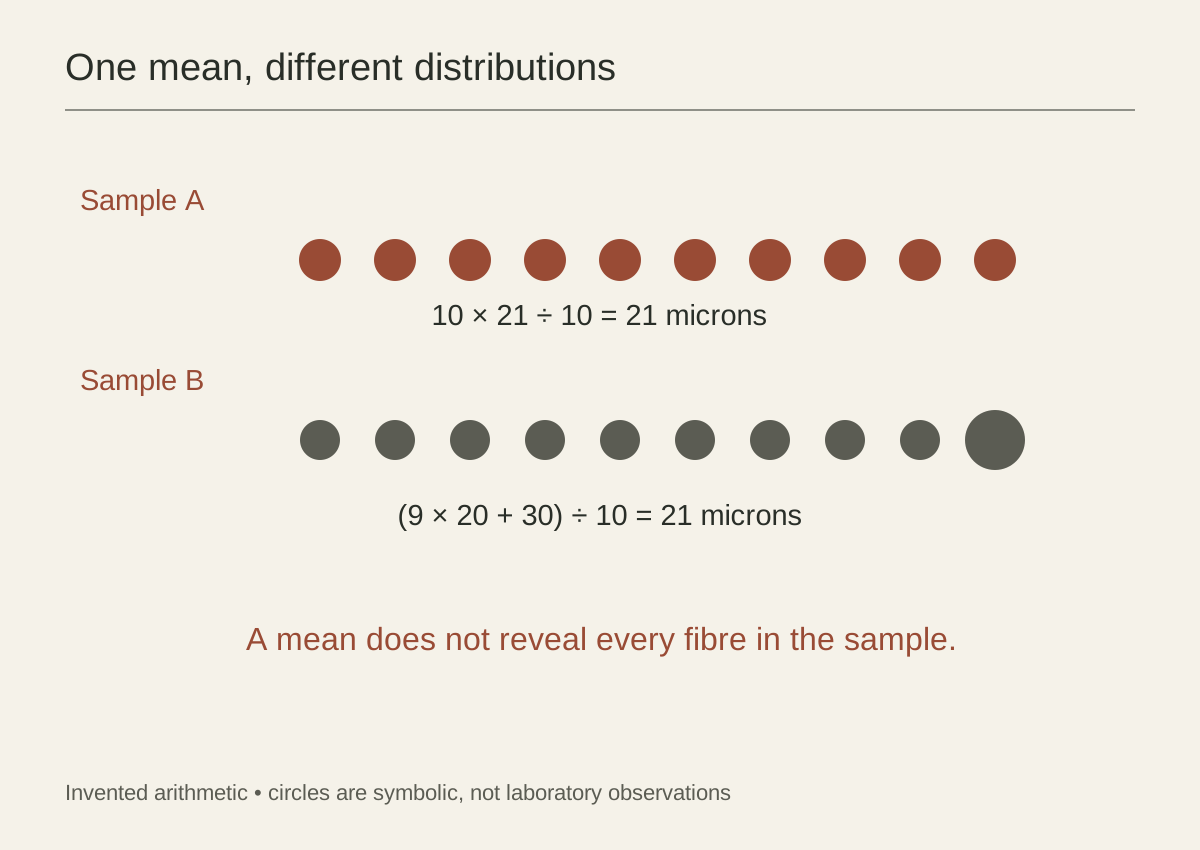
Consider a deliberately simplified arithmetic example. Ten fibres all measuring 21 microns have a mean diameter of 21 microns. Nine fibres measuring 20 microns and one measuring 30 microns also average 21 microns: (9 × 20 + 30) ÷ 10 = 21.
These are invented numbers used to explain an average, not measurements from real alpacas or a study. The example shows why a mean alone cannot reveal every fibre in a sample. It does not predict how either hypothetical group would feel in clothing.
The Alpaca Owners Association’s fibre standard discusses fineness and uniformity rather than relying only on commercial grade names. If a test report is offered, look for its scope and additional information instead of reading only the largest number.
Identify the claim before comparing it
| Number in a listing | Useful follow-up |
|---|---|
| ‘Average 21 microns’ | Average of what sample, measured when and how? |
| ‘Under 23 microns’ | Is this a grade definition, an average limit or an individual-fibre claim? |
| ‘20–23 microns’ | Is this a sorting range, reported sample range or supplier category? |
| A grade name with no number | Which classification or supplier definition applies? |
| A fleece test certificate | Does it relate to the lot used in this product? |
Use the table to identify the next missing field, rather than collect more decimals. These are hypothetical listing phrases; the report-reading order below puts a supplied answer back beside its sample.
Read a report in a useful order
Read in this order: sample identity and date; unit and statistic; variation and method; connection to the offered product or yarn lot. A supplier’s fineness-category table describes a classification, while a report describes its identified sample. Neither verifies an unrelated garment. AOA’s published standard refers to average diameter and standard deviation in discussing uniformity; a lower average alone is not the whole description.
A seller might show a real report for a named fleece while offering a sweater knitted from blended yarn. The missing link is the relationship between that fleece, the spun lot and the garment, not another decimal place. Record ‘report supplied; product connection not established’ until that link is explained.
For a numerical comparison, put means beside means and category limits beside category limits. ‘Average 21’ and ‘under 23’ do not necessarily express the same kind of claim, even though both contain a small number.
Save the number with its meaning
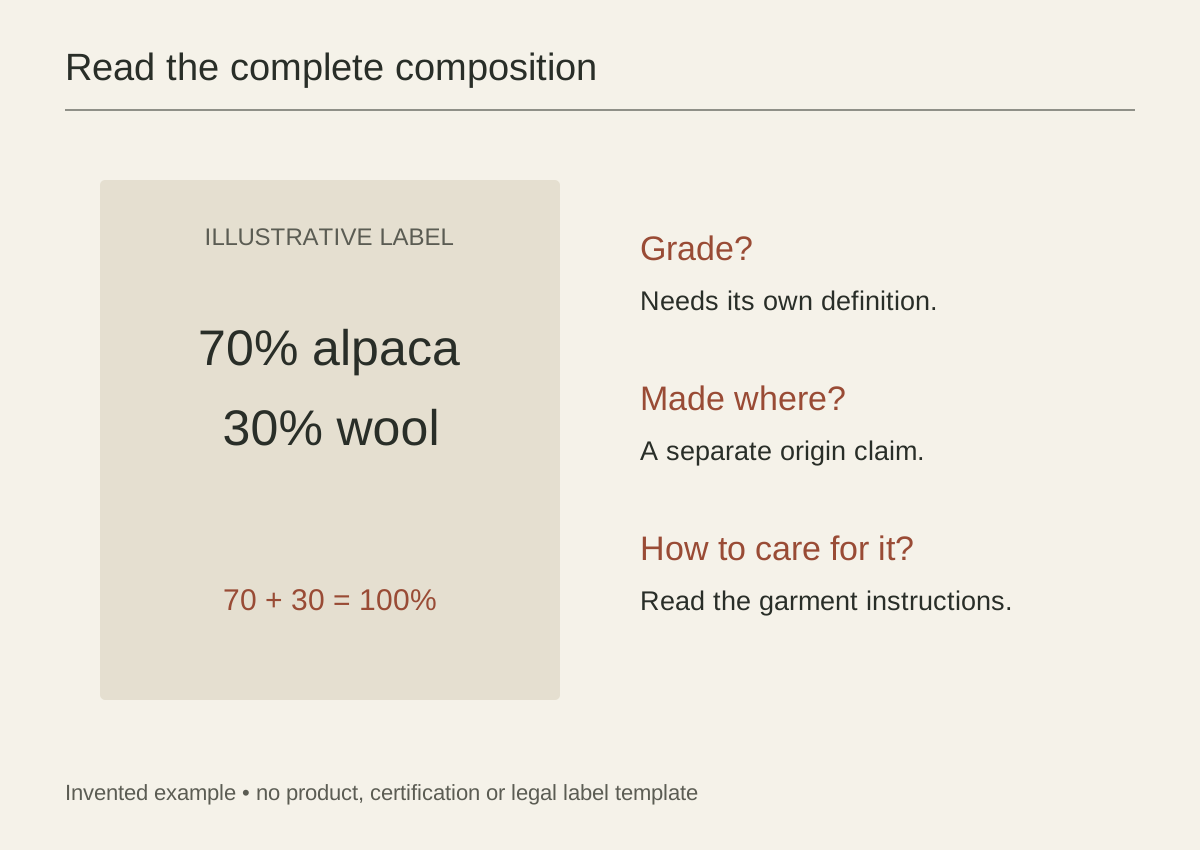
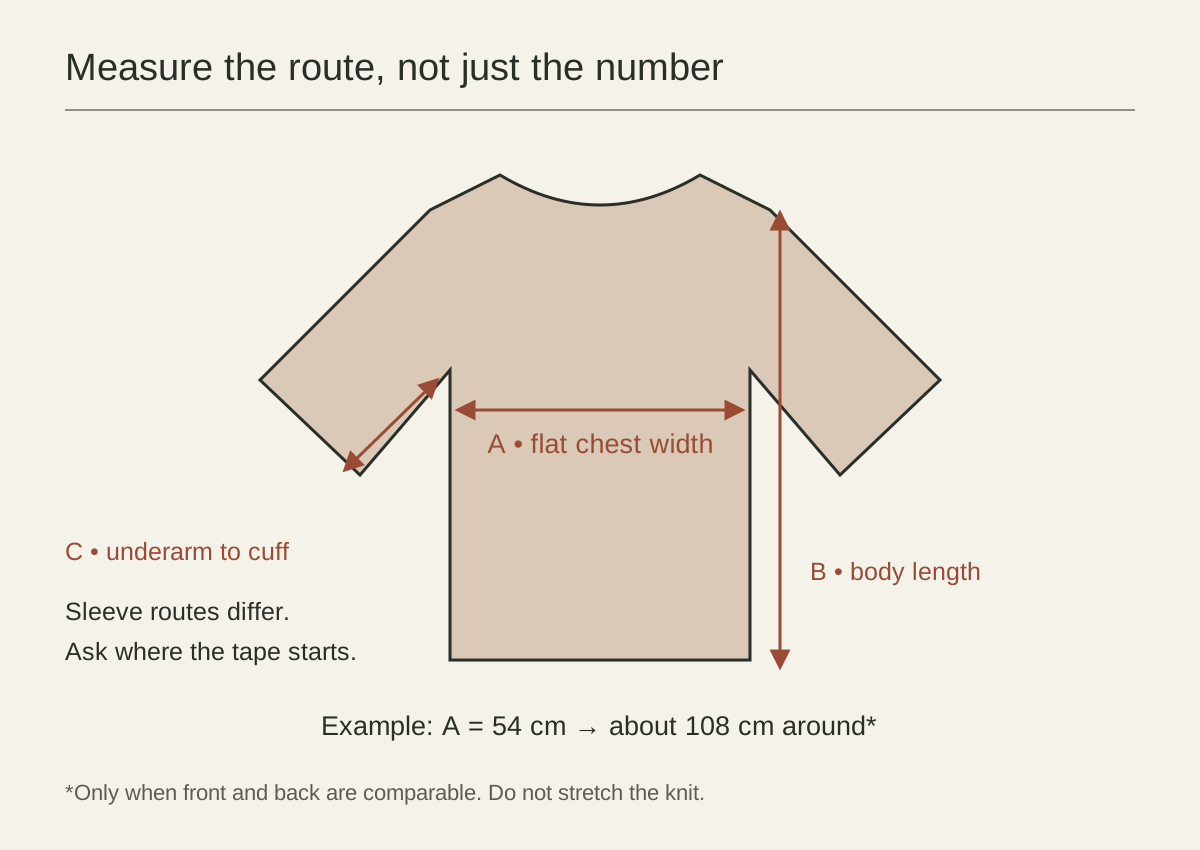
‘21 microns’ loses useful information when copied without its statistic, sample or source. Keep those together in your notes, including any unexplained product connection. Use the blend reference if the measured fibre is only one ingredient. For finished dimensions rather than fibre diameter, use the sweater sizing guide.