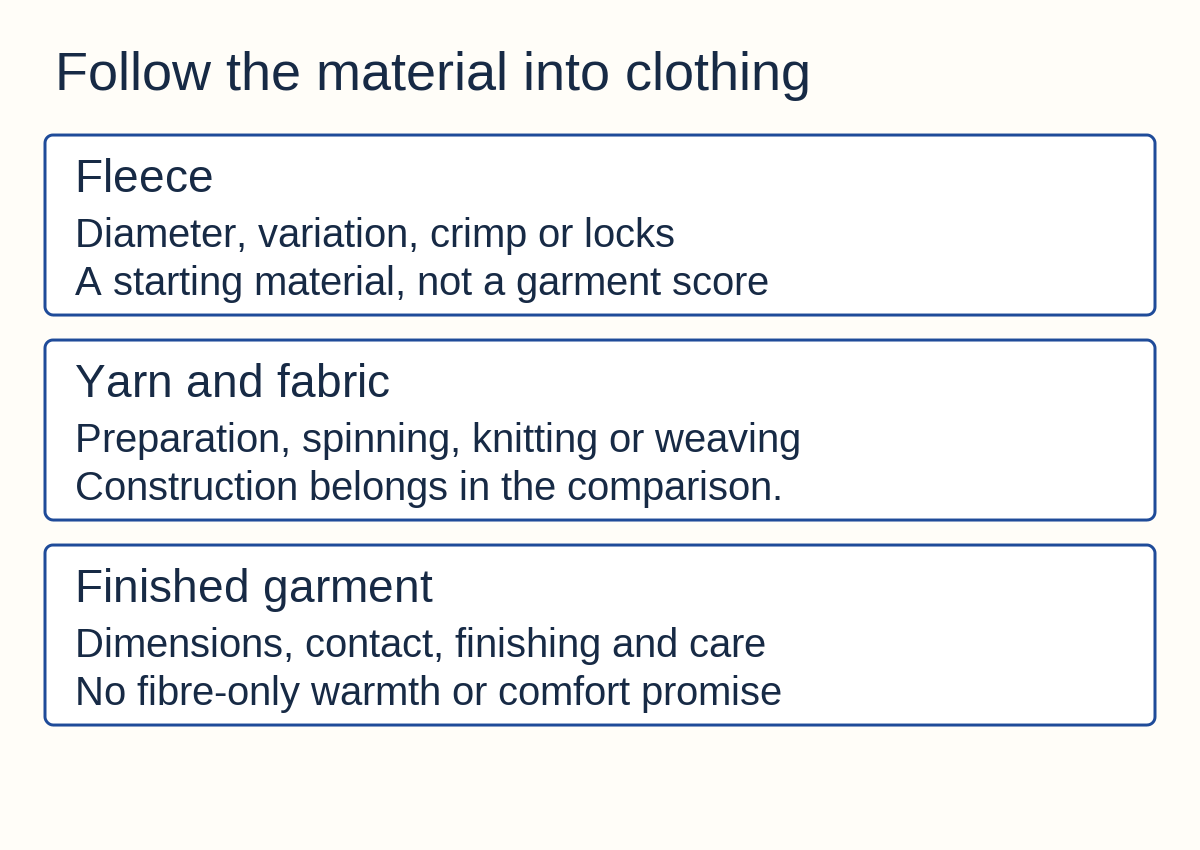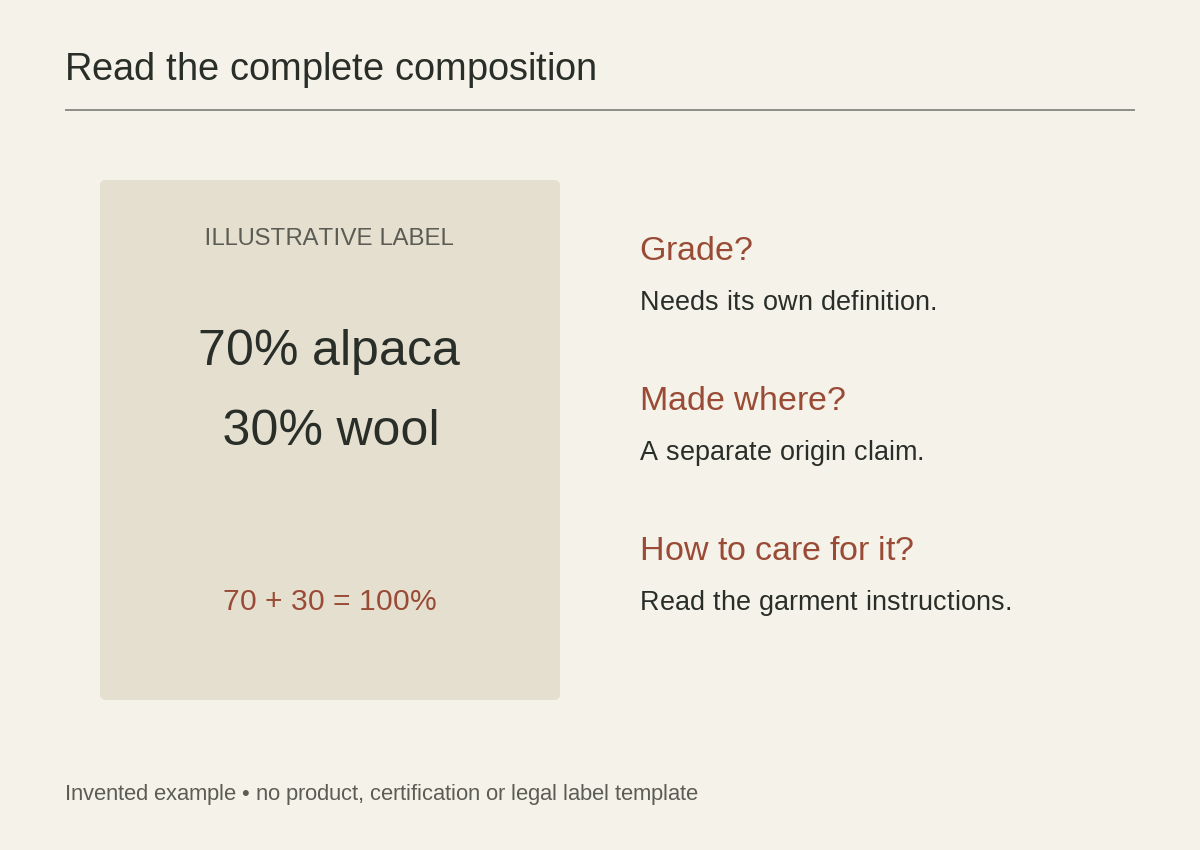
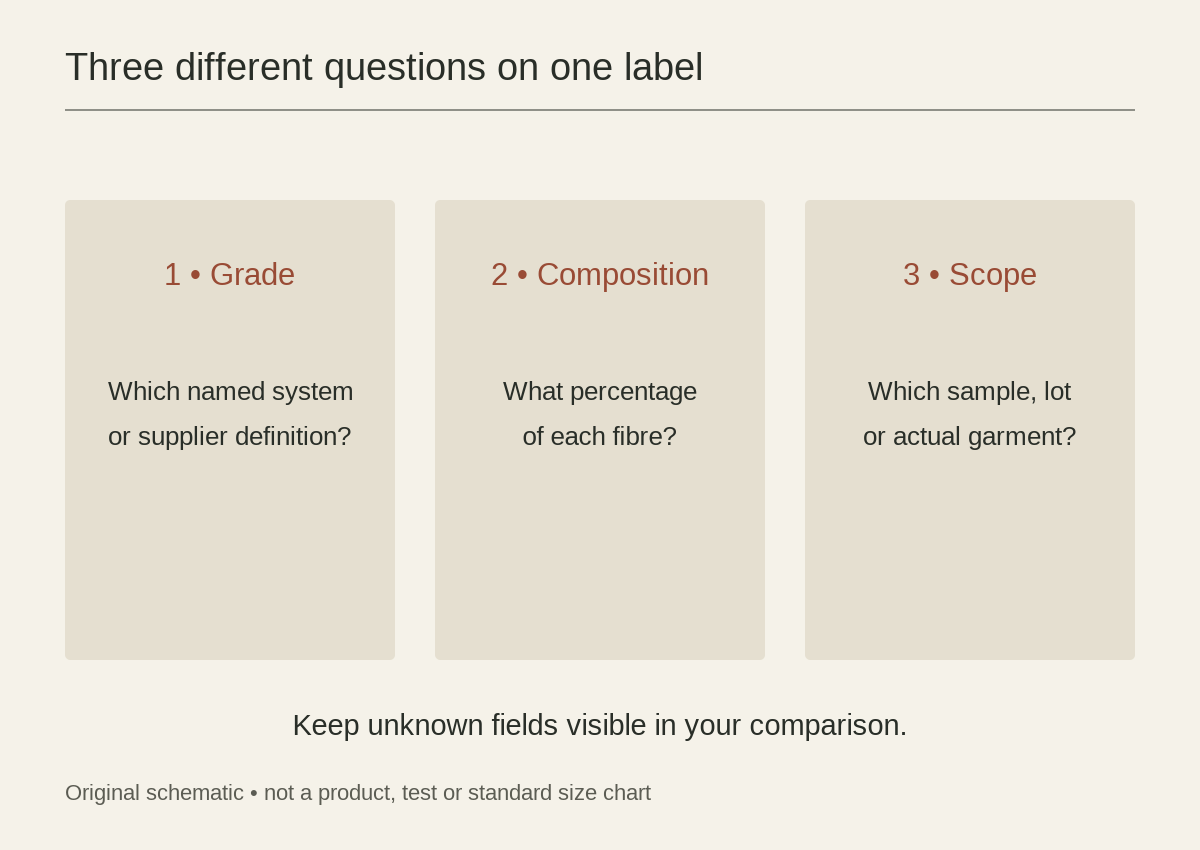
Compare alpaca grades only after identifying the classification behind each label. A numbered fibre grade, a supplier’s commercial name and a measured diameter can describe related information without being interchangeable. Write down what each claim actually says before ranking the garments.
This guide concerns classification systems. The alpaca overview covers the wider garment decision, while the fibre reference explains why fineness alone cannot predict every aspect of wear.
Three descriptions that can look more alike than they are
A commercial name such as baby or superfine may be defined by a supplier or a particular standard. A numbered grade belongs to its specified system. A test result records measurements made on a sample, with whatever method and scope are reported.
If a listing switches between those descriptions without explaining the relationship, ask for clarification. A buyer should not need to assume that the number in one system has the same meaning as a word in another.
The Alpaca Owners Association’s published U.S. standard is an instructive example: it uses numbered micron spans and notes that familiar grade names were not assigned because the names were inconsistent internationally. Sol Alpaca publishes its own named categories and diameter information. Read each within its own context.
Two real definitions, kept in their own systems
These selected entries are taken from the pages accessed for this manuscript. They show why the source of a number matters; the rows are not a conversion between systems.
| Source and classification | Selected published entry | What it describes |
|---|---|---|
| Alpaca Owners Association, U.S. Alpaca Fiber Standard | Grade 1: 17.0–19.9 microns | One numbered micron span in that standard |
| Same AOA standard | Grade 2: 20.0–22.9 microns | Another numbered span; no commercial name is assigned |
| Sol Alpaca, its fibre table | Baby Alpaca: 21–22.5 microns | That supplier’s named category |
The numerical overlap between the last two rows does not make ‘Grade 2’ and every use of ‘baby alpaca’ interchangeable. These are different definitions, and neither row certifies an item in a shop. AOA’s full standard also addresses processing length and uniformity; a shortened shopping table is not a substitute for it.
Compare definitions, then decide whether comparison is possible
For each claim, copy three things: the exact term, the source that defines it and the kind of numerical boundary. In the table above, the AOA intervals and Sol Alpaca’s supplier category have different endpoints and naming rules. Their overlap does not supply a two-way conversion.
For example, a label saying only ‘baby’ cannot be assigned to AOA Grade 2 from this table. A seller citing the AOA system should instead identify the numbered grade and applicable specification. Record an unspecified system as unspecified.
Do not create a universal conversion chart
Follow a short decision route. If a classification is named, record its source and applicable version or specification. If only a commercial word is supplied, obtain the supplier’s definition. If that definition remains absent, leave the system unspecified rather than assigning a numbered grade yourself.
The selected source entries above were read on 16 October 2026. They identify the pages compared, not a universal current edition for every supplier. A chart merging “royal”, “baby” and “superfine” into one ladder would discard the naming differences that prompted the comparison.
Keep a test result in a separate column
A measured sample mean is another kind of information. It does not become a classification interval because it falls between two endpoints. If a seller supplies a report, preserve its sample identity and ask how it connects to the product; do not add it as another row in a universal grade ladder.
What this comparison leaves you with
You may finish with two clearly attributed definitions rather than a first-and-second-place ranking. If a grade applies only to the alpaca ingredient of a blend, keep the complete composition beside it; the blend reference explains that separate field. The result is a defensible comparison of what the sellers actually claim.